
Criminal Court Cases in Dodge County
Dodge County criminal cases do not all begin or remain in one office. Superior Court, part of the Oconee Judicial Circuit, has exclusive felony trial jurisdiction. Magistrate Court handles arrest warrants, first appearances, bond issues, preliminary hearings, and other early steps. Municipal courts address city ordinance and traffic matters within their authority. Juvenile Court operates under separate confidentiality rules, so its records are not a substitute for an adult criminal docket.
The Superior Court clerk is the custodian of filed felony cases, including accusations, indictments, docket entries, judgments, sentences, and certified copies. The clerk counter is at 643 Pearl Bates Avenue in Eastman. A request should name the court, case number if known, party, filing period, and exact document sought. Sending that request to the general county clerk can add delay because the county policy directs people to the department that owns the record.
Dodge Superior E-Access
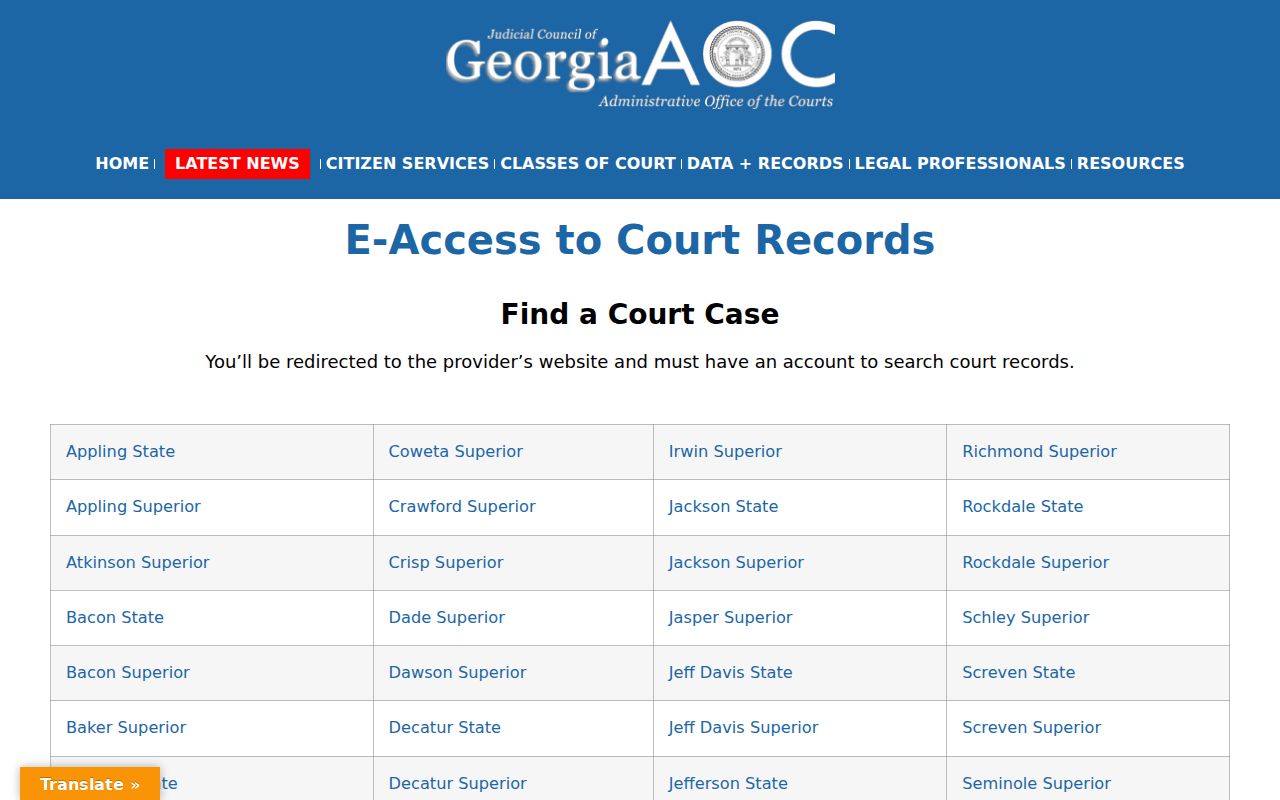
Georgia Courts E-Access lists Dodge Superior Court and routes the user to its outside case provider. The state directory warns that the destination requires an account. That makes E-Access a doorway, not a single statewide database with uniform fields or free document images. Provider screens and document access can change, while the state directory remains the durable official starting point.
The official E-Access listing below shows why selecting the correct participating court matters.
Once inside, compare more than a name. Case number, court, filing date, charge, status, and disposition help separate people with similar names and distinguish a pending prosecution from a closed one.
Dodge County Case Record Searches
Remote access is useful for locating a docket, but the Dodge County Superior Clerk remains the fallback for a missing document, archived file, certified copy, or account problem. Magistrate Court is the separate fallback when a warrant or first appearance has not yet produced a Superior Court filing.
- Open Georgia Courts E-Access and select Dodge Superior Court.
- Create or sign in to the provider account, then search by party name or case number.
- Narrow possible matches with the filing date, case type, court, status, and charge.
- Open the docket and read the accusation or indictment, hearings, plea or trial entry, judgment, and sentence.
- Call the Superior Clerk at 478-374-2871 for omitted or archived papers, copy costs, and certification. Call Magistrate Court at 478-374-7243 for its early-stage records.
The research did not confirm a stable set of vendor input labels, so do not assume every screen offers date of birth or a criminal-only filter. These are the verified search routes and comparison fields.
| Search item | Use | Limit |
|---|---|---|
| Party name | Find candidate cases | A name alone is not identity proof |
| Case number | Reach a known docket | Must match the correct court |
| Filing date | Narrow a common name | Not the arrest date |
| Status and disposition | Separate pending and closed cases | Read each charge count |
| Docket entries | Track hearings and orders | Documents may require an account or clerk request |
Dodge Clerk Counter Searches
Clerk Rhett Walker's office is the direct source for a Dodge County felony file that is incomplete online. Ask whether the case is archived, whether a plain copy will serve the intended personal purpose, and what a certified copy will cost. The research found no official Dodge certified-copy fee, so obtain a quote rather than relying on a fee stated by a private directory.
Dodge Superior Court Clerk
643 Pearl Bates Avenue
P.O. Box Drawer 4276
Eastman, GA 31023
478-374-2871
Dodge Magistrate Court
5018 Courthouse Circle, Suite 202
Eastman, GA 31023
478-374-7243
Call before travel because current counter hours, security rules, device limits, and accommodation contacts were not confirmed in the official sources. The 1908 courthouse history also matters here: older Dodge County court records can span paper, archive, and electronic systems.
What a Criminal Case File Contains
A Dodge County court file records what prosecutors filed and what the court did. It is therefore more reliable for a final outcome than the initial jail charge. Public online views may omit documents, sensitive identifiers, victim or minor information, and sealed material. A docket entry can still tell a reader that an order exists even when the document image is unavailable.
| Case Number and Court | Identifies the file and the Dodge County court that owns it. |
|---|---|
| Charging Document | Shows an accusation, indictment, count, offense description, and citation. |
| Docket Entries | Chronological filings, motions, calendars, hearings, and orders. |
| Parties and Counsel | State, defendant display, and attorneys when public. |
| Disposition and Judgment | Shows dismissal, nolle prosequi, acquittal, plea, verdict, or other outcome by count. |
| Sentence and Financial Entries | May show confinement, probation, fines, costs, or restitution. |
Read the count-level outcome, not just the case status. One charge can be amended or dismissed while another ends in a plea or verdict. “Closed” describes the docket's posture, but it does not explain why each count ended.
Reading Dodge County Case Terms
Georgia court language becomes clearer when each term is tied to its place in the Dodge County felony path. These labels are outcomes or procedural steps, not synonyms.
- Accusation
- A prosecutor's formal charging instrument used where Georgia law permits.
- Indictment
- A grand jury's true-bill charging document.
- No bill
- The grand jury declined the proposed indictment.
- Nolle prosequi
- The prosecutor formally declined to continue a charge at that time.
- Disposition
- The recorded result of a charge or case.
- Capias
- A court command to take a person into custody, often after a missed required appearance.
A booking label can diverge from the accusation or indictment because the prosecutor screens the evidence after arrest. That is why the Dodge County arrest search and the clerk's case file answer different questions.
Criminal Case Stages in Dodge County
The Dodge County felony path normally begins with an arrest and first appearance, then moves through prosecutor review. A case may proceed by accusation where lawful or by grand-jury indictment. Arraignment records the plea. Motions, calendars, a negotiated plea, or a trial follow before judgment and sentence. Appeal or supervision entries can continue after sentencing.
Case flow: Arrest → First appearance and bond → Prosecutor screening → Accusation or indictment → Arraignment → Pretrial motions → Plea or trial → Disposition → Sentencing
There is no safe fixed timetable in the research. Filing, grand-jury, calendar, and trial timing depend on the case and the Oconee Judicial Circuit schedule. A recent booking may therefore have no Superior Court result yet. Check Magistrate Court for the first-stage trail and return to the Superior docket after prosecutor review.
Three Dodge County Case Layers
A single event can create records in three local offices before any statewide history is complete. The arresting agency holds its incident narrative. Magistrate Court may hold the warrant, first appearance, bond, and preliminary material. Superior Court holds the filed felony prosecution and final judgment. GCIC later receives arrest and disposition reports from source agencies.
| Layer | Best question | Official route |
|---|---|---|
| Magistrate record | Was a warrant issued or an early hearing held? | Magistrate Court |
| Superior docket | What charge was filed and how did it end? | E-Access and Superior Clerk |
| GCIC history | What statewide arrest and disposition data is linked to the identity? | GBI personal-review channels |
If GCIC lacks a final disposition, the court judgment can supply the proof needed for a source-agency correction. GBI cannot simply rewrite an event without documentation or authorization from the agency that owns the disputed entry.
Access Rules for Case Records
The Georgia Open Records Act favors access to agency records unless a specific exemption applies. Court files also operate under court access and sealing rules. Social Security numbers, full sensitive identifiers, victim information, minor information, and security-sensitive material may be redacted. Juvenile cases are not ordinary adult public files. Active-investigation records held by police may also remain restricted even when a related public court docket exists.
Georgia record restriction under O.C.G.A. §35-3-37 limits qualifying GCIC dissemination for non-criminal-justice purposes. It does not destroy every agency copy. Sealing the related court file is a separate step under subsection (m). A case missing from a public search may be sealed, archived, filed under a different format, not yet filed, or simply outside the provider's available documents.
Three business days under the Open Records Act is a response duty, not a promise that every archived file will be produced within three days. A proper response may produce records, identify a later production time, estimate lawful costs, or cite the exemption that supports withholding.