
Arrest Records in Dodge County
Dodge County arrests may be made by the Sheriff's Office, Eastman Police, Georgia State Patrol, GBI during a referred investigation, or another agency acting within its authority. The named arresting agency creates the incident or arrest narrative. Dodge County Jail creates the booking record when a person enters local custody. Magistrate Court may then create a warrant, first-appearance, and bond trail, while Superior Court creates a felony prosecution only if charges are filed.
Those records answer different questions. An agency narrative describes the alleged event and officer action. A booking sheet records intake, initial charges, bond, and custody. The court docket shows the prosecutor's filed charge and eventual outcome. GCIC can receive fingerprint-linked arrest and disposition data, but updates depend on the agencies that own each event.
No Dodge County Booking Log
The official sheriff has a Jail Population page describing current population and bond-arraignment information. During research, however, it exposed no dependable public form fields or neutral result that could support a complete self-service booking search. Treat it as the first official online stop, then use the jail telephone and sheriff request route if it does not return the needed record.
This gap is important. Absence from a visible page is not proof that no Dodge County arrest occurred. A person may have been released, transferred, booked under a different name form, or never entered Dodge custody. Recent custody changes may also post on a different schedule from court and GCIC updates.
Dodge County Arrest Lookups
A channel-complete Dodge County arrest search starts with the event, not a broad name query. Gather the full booked name, approximate date and time, location, arresting agency, and any booking, incident, warrant, or case number. Then follow the official chain that fits the question.
- Check the sheriff's official Jail Population page, then call Dodge County Jail at 478-374-8131 for present custody, booking identifier, and bond information.
- Ask the named arresting agency for its incident or arrest report. For sheriff records, use the March 2026 policy contact at 478-559-1130 or tgraham@dodgecosheriff.com.
- Check Magistrate Court for a warrant, first appearance, preliminary matter, or bond trail, and Dodge Superior E-Access for a later felony filing.
- For public Georgia felony convictions, use Georgia Felon Search. For one's own identity-linked statewide history, use GCIC's fingerprint personal-review route through GAPS.
- Submit a narrow Georgia Open Records Act request when the online and telephone routes do not supply the releasable document.
GDC Offender Search is a later custody channel for sentenced state offenders. It is not the primary roster for ordinary Dodge County pretrial custody and excludes successfully completed First Offender records.
Dodge Sheriff Arrest Requests
Dodge County's March 2026 Open Records Policy names a specific sheriff route at 85 Industrial Boulevard in Eastman. A useful request asks for a record rather than asking staff to answer a general question. State the incident date or range, location, involved agency, full name, known identifier, record type, and preferred delivery format. Ask separately for an arrest report, booking sheet, photograph, warrant return, CAD log, or body-camera file because each may have a distinct exemption and production cost.
Dodge County Sheriff's Office
85 Industrial Boulevard
Eastman, GA 31023
tgraham@dodgecosheriff.com
478-559-1130
Dodge County Jail
5401 Anson Avenue
Eastman, GA 31023
478-374-8131
The policy gives the first 15 minutes of a qualified employee's search and retrieval time without charge. Further search, retrieval, review, or redaction may be billed at the rate of the lowest-paid qualified employee, and letter or legal copies can cost up to ten cents per page. Request an estimate for video or a large file.
Arrest Records: What They Contain
A Dodge County booking inquiry can include core intake fields, but the research does not claim that every field is shown on a public screen. Medical details, suicide-watch information, housing assignments, and security classifications should be treated as nonpublic unless the sheriff expressly releases them. Booking photographs also remain subject to agency release rules and any applicable exemption.
| Booking Number | Local identifier used to locate the jail intake event. |
|---|---|
| Booking Date and Time | When the person entered Dodge County Jail custody. |
| Arresting Agency | The sheriff, police, state, or other agency that made the arrest. |
| Initial Charges | Allegations recorded at intake, which prosecutors may amend or decline. |
| Warrant or Case Reference | Connects the booking to a court or agency record when available. |
| Bond | Type and amount by charge when public and set. |
| Custody or Release Status | Whether the person remains held, was released, or transferred. |
| Booking Photograph | An intake image that may be withheld or separately requested under current rules. |
A name and photograph are not enough to confirm identity. Compare the booking number, date, agency, court reference, and later case disposition. Do not use private inmate or mugshot aggregators to fill a gap in the official Dodge County record.
Four Dodge County Arrest Records
One arrest can make four local documents, plus a statewide entry. The agency narrative, jail booking, Magistrate record, and Superior case update on different schedules. Fingerprints and event reports can then reach GCIC, where the disposition may remain blank until the source court or prosecutor reports it.
Record flow: Agency report → Jail booking → Magistrate warrant, first appearance, or bond → Superior accusation or indictment → GCIC arrest and disposition cycle
A 2025 Eastman case documented by GBI illustrates the split: Eastman Police requested the state investigation, the accused was booked at Dodge County Jail, and the charges later changed. The press release is a useful lead to the event, but it is not the final Dodge County court disposition.
Recent Dodge County Bookings
Recent booking information is most reliable when confirmed with Dodge County Jail. The official facility listing below supplies the jail contact and location used for the fallback inquiry. Georgia Department of Corrections lists the county jail even though GDC's state Offender Search serves a different custody layer.
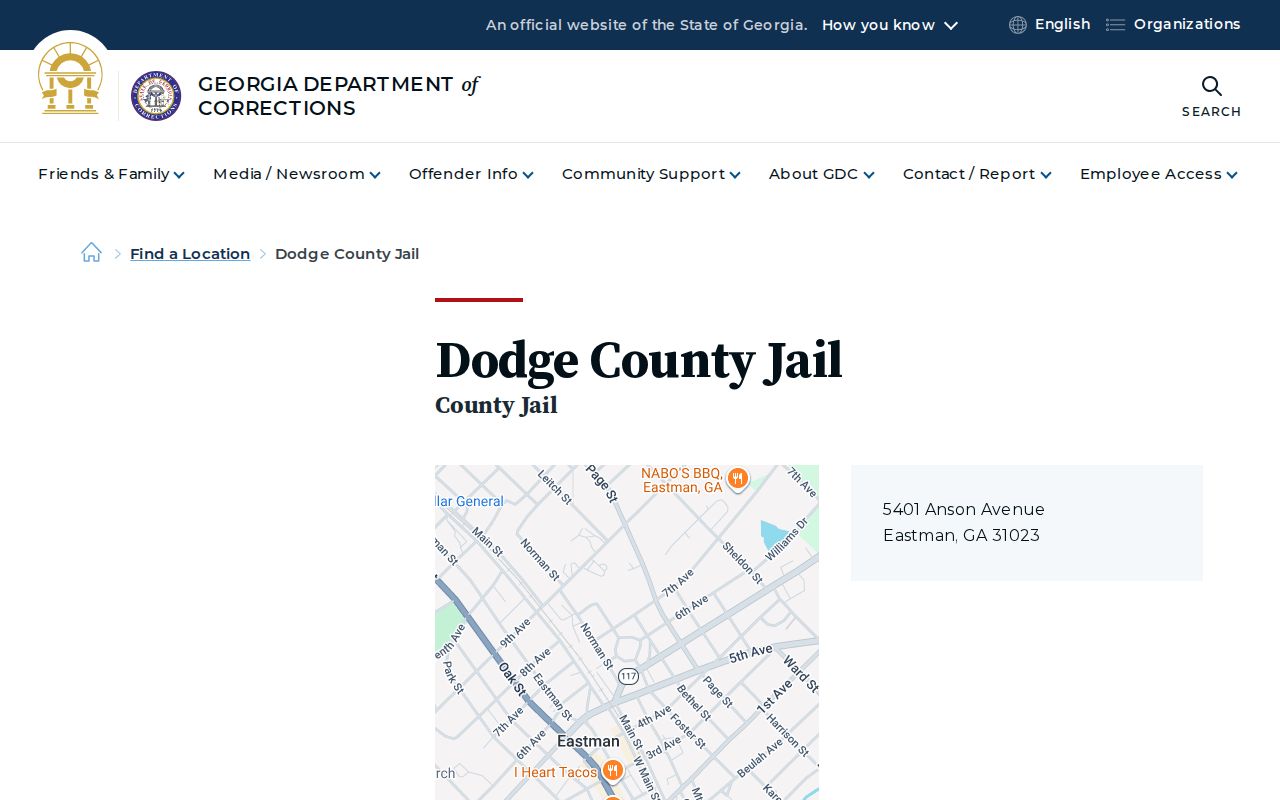
Rosters are snapshots, not lifetime arrest histories. A released person may disappear, a transferred person may move to another locator, and an incident report can exist without a booking. Call before travel because sources publish different sheriff functions at separate Eastman addresses.
Why GDC Misses Dodge Bookings
GDC Offender Search covers current or past state correctional custody, not ordinary local pretrial detention. Its search accepts a name, GDC identifier, or case number. GDC advises trying the first four surname letters and selecting all offenders if a narrow active search fails. Successfully completed First Offender records are not published.
The official state locator interface shown below reinforces that custody distinction.
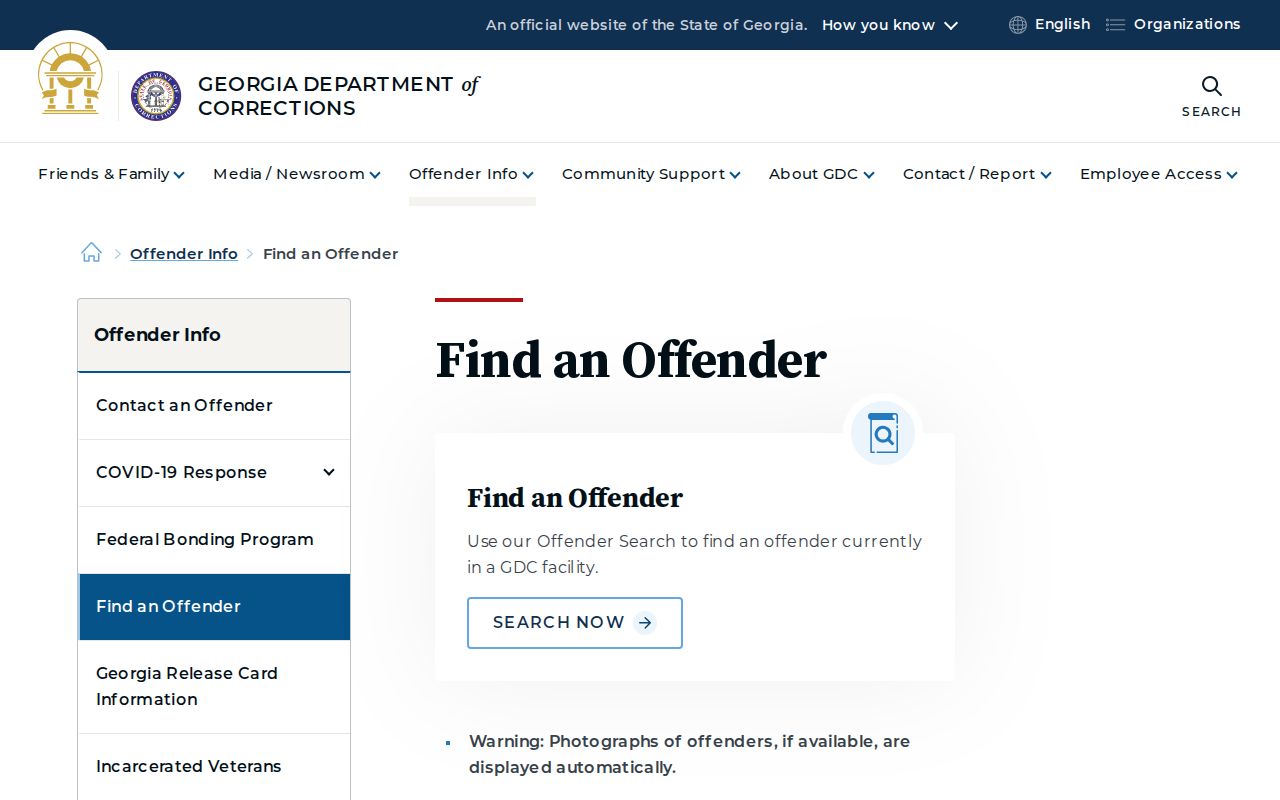
Use the jail for current county custody, GDC after a state sentence, and the Superior Clerk for the adjudicated case. A blank GDC result does not rule out a local booking or pending prosecution.
Dodge Arrest Report Costs
The arresting agency owns its narrative. A Dodge deputy's report goes through the sheriff route, an Eastman Police report through the city police channel, and a Georgia State Patrol record through the Department of Public Safety. The DPS fee guidance explains that copy and media production can carry lawful charges.
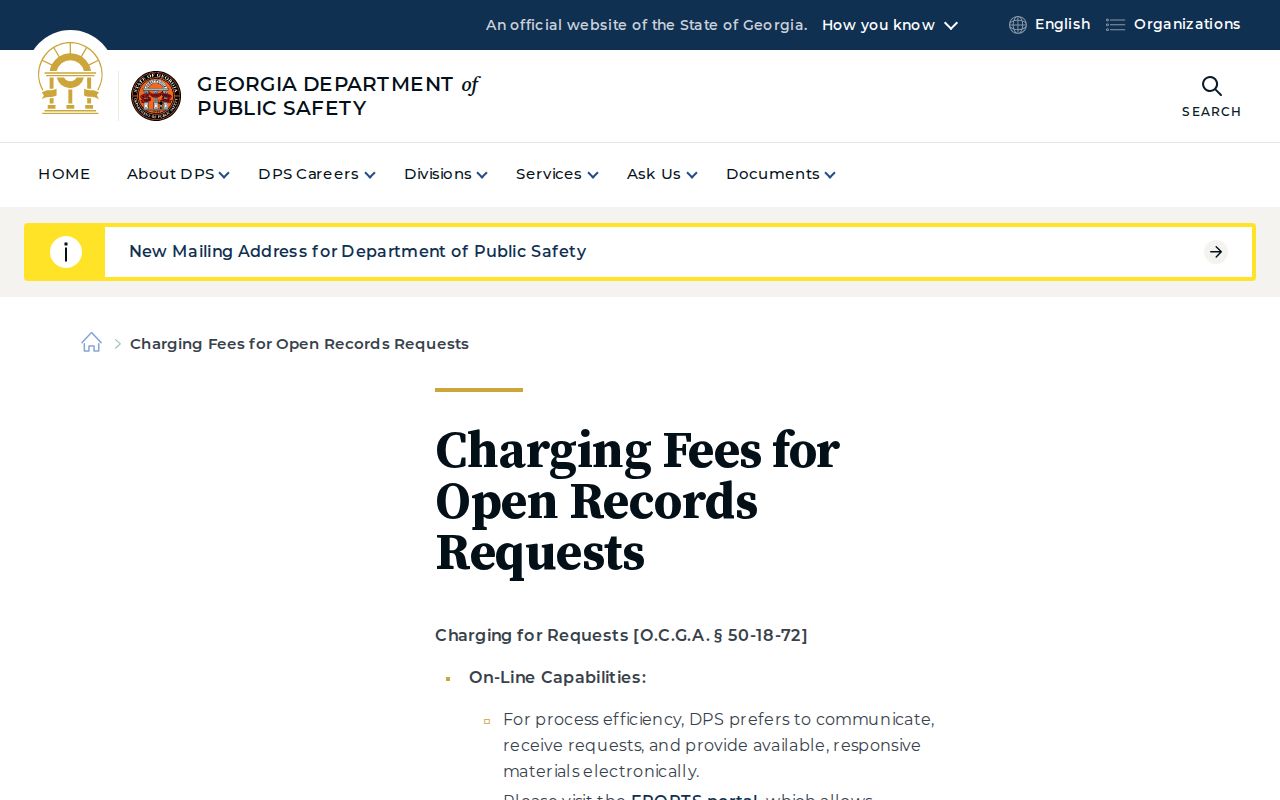
Active investigations, juvenile data, victim identifiers, medical facts, confidential sources, and security-sensitive jail details may be redacted or withheld. Under the Georgia Open Records Act, the agency generally responds within three business days by producing available records, setting a production time, giving a cost estimate, or citing the exemption. That clock does not guarantee full production of a large video within three days.
Correcting a Dodge Arrest Cycle
A dismissal in Dodge Superior Court does not automatically erase the arresting agency's report, the jail intake file, and every GCIC entry. Georgia record restriction may limit qualifying nonconviction information, while court sealing is a separate process. A person reviewing their own record should first obtain the court disposition and identify which agency entry is wrong or incomplete.
GCIC correction work depends on source documentation. Useful identifiers include full name, date of birth, race, sex, arrest date, SID and arrest date, or the OTN for the event. GBI cannot change a submitted arrest or disposition merely because a reader reports a mismatch. The arresting agency, prosecutor, court, or supervision office that owns the entry must supply or authorize the correction.
Arrest Records vs Conviction Records
An arrest documents custody based on an allegation and probable cause. A conviction is a court judgment of guilt after a plea or verdict. The distinction is vital in Dodge County because an initial booking charge may be amended, merged, dismissed, no-billed, or never formally accused.
| Point | Arrest record | Conviction record |
|---|---|---|
| Creator | Arresting agency and Dodge County Jail | Dodge Superior Court or another sentencing court |
| What it shows | An arrest and intake allegation occurred | The court entered guilt on a charge |
| Best source | Agency report, jail, and Magistrate trail | Clerk docket, judgment, and qualifying GCIC product |
| Possible ending | Release, no filing, dismissal, or later prosecution | Sentence, appeal, restriction, or sealing where eligible |
Note: A Dodge County arrest is not proof of guilt, and many intake charges change or never result in conviction.
To trace the filed charge and final outcome, use the Dodge County court case lookup and confirm the count-level disposition with the clerk.